Guest guide
The Dampier Strait, a passage for whales and dolphins in the heart of Raja Ampat
Sperm whales, Bryde's whales, Omura's whales and even orcas have been recorded passing through and feeding in the Dampier Strait. What is proven, when your chances are better, and how to watch them without disturbing them.

DAMPIER team
November 3, 2026 · 6 min read
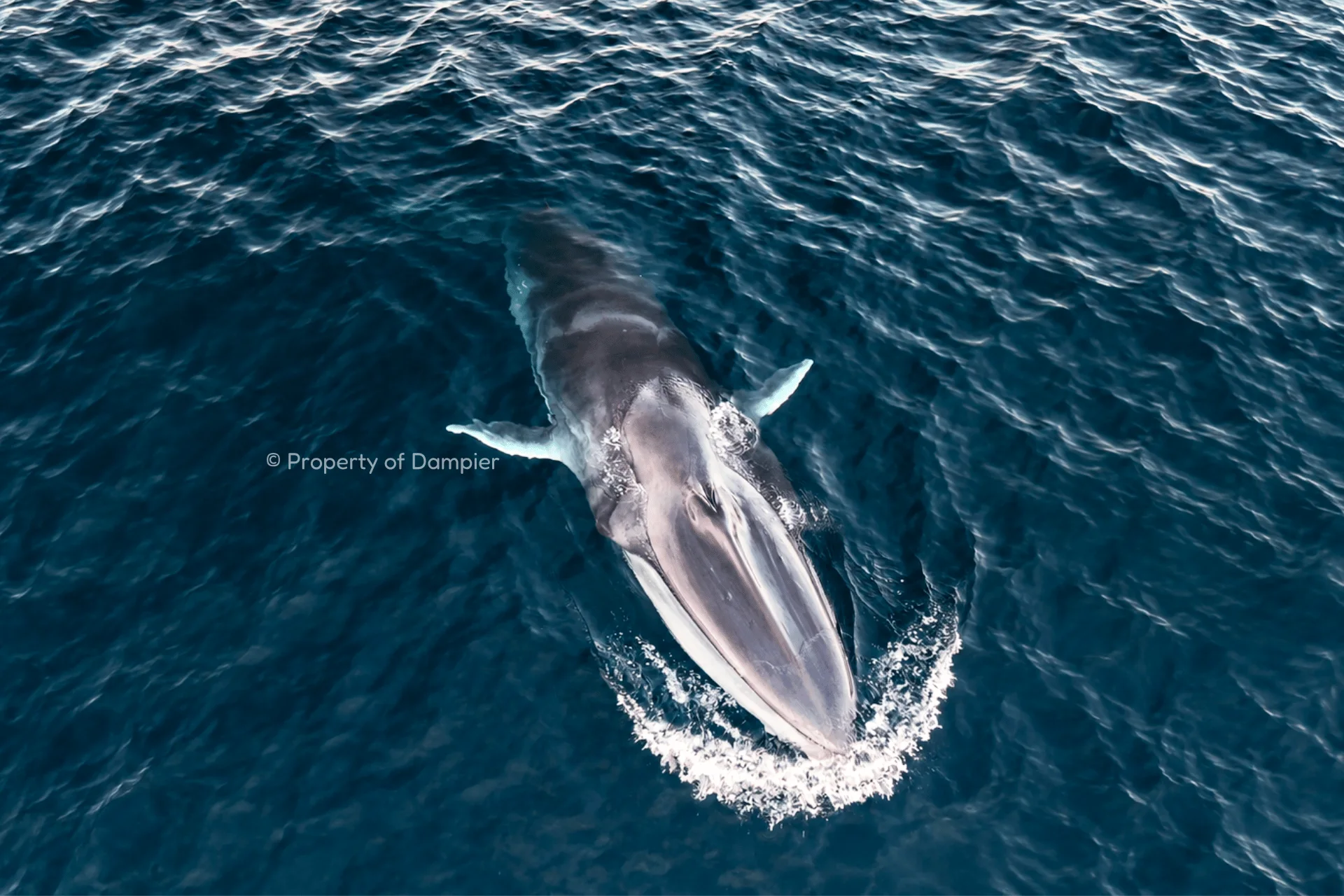
The Dampier Strait, the water between Waigeo and Batanta islands, is famous for manta rays and dense reefs. What few guests know is that the same strait is also often crossed by whales and dolphins. Researchers describe it as one of the busiest places for marine mammals in Raja Ampat, and the Sorong–Waisai fast ferry crosses it every day.
Why whales pass through the Dampier Strait
The strait is much deeper than it looks. A survey by the research vessel Baruna Jaya VIII in 2007 recorded dolphins over water more than 800 metres deep inside the strait, and the seabed drops steeply not far from shore. At its western end the strait opens onto the Halmahera Sea, one of the doorways through which Pacific water enters Indonesian seas. Its tidal currents are strong and carry plankton and small fish, the same food that brings in the mantas. Deep water close to the islands and plenty of food mean whales and dolphins can turn up on the same routes as guest boats.
Whales and dolphins on record
A survey from 2006 to 2011 recorded 13 species of whales and dolphins in central and southern Raja Ampat, and most sightings were around Kofiau, the Dampier Strait and the Sagewin Strait. Monitoring by Benjamin Kahn from 2011 to 2015 raised the list to 16 species. These are the most frequent and the most exciting to meet.
- Spinner dolphins, the most commonly seen. They usually travel in groups of 15–20, love to leap and spin, and are in the strait all year round.
- Bottlenose dolphins and Indo-Pacific humpback dolphins, which have resident groups in Raja Ampat.
- Bryde's whales, baleen whales that can reach around 15 metres. Researchers report seeing them regularly in the Dampier Strait.
- Sperm whales, the largest toothed whales, which dive hundreds to more than a thousand metres to hunt squid. They are also often recorded in the strait.
- Omura's whales, among the least known whales in the world, described as a species only in 2003. One was recorded in the Dampier Strait in April 2023, and in March 2026 marine biologist Mark Erdmann filmed one by drone lunging at krill on the surface of the strait.
- Short-finned pilot whales, met fairly often in groups.
- Orcas, or killer whales, which are rare. A single adult orca was recorded in the Dampier Strait in January 2015.
- Risso's dolphins, false killer whales and pygmy killer whales, seen now and then.
Migration route or home
The Dampier Strait is often called a migration route or a whale highway. The reality is a little different. No tracking study, by satellite tag or by photo identification, has yet shown whales migrating long distances through the strait. What is proven is that whales and dolphins regularly pass through and feed here.
Researchers think Raja Ampat matters for whales on the move, because the species seen change from season to season. But most of the whales in the Dampier Strait are warm water residents that do not make long migrations. Bryde's and Omura's whales live in tropical waters all year, and Mark Erdmann describes Omura's whales as resident in Raja Ampat. Female sperm whales and their calves also stay in tropical seas all year round. So the Dampier Strait is better described as a passage and feeding ground that whales use often, rather than a road they travel once a year.
When your chances are better
Whales can appear at any time, but they cannot be scheduled. In the 2006–2011 survey, the most species were recorded in January–February, May and October–November. Early notes from a research team in the Dampier Strait describe Bryde's and sperm whales mating and calving, most often from December to early March. The sea is usually calmest around October–April, and on a calm sea a whale's blow is far easier to spot.
Where to look
- From the Sorong–Waisai fast ferry. It cuts across the Dampier Strait every day, and researchers once saw a sperm whale right in its path. Take a seat by a window or on the outside deck and watch for blows and dorsal fins at the surface.
- On the longboat crossing from Waisai to homestays on Kri, Mansuar, Arborek or Gam.
- On the way to dive sites such as Blue Magic and Cape Kri, where spinner dolphins are seen fairly often.
No operator can promise whales. Treat every sighting as a bonus on your trip.
How to behave around whales and dolphins
Whales and dolphins are protected species in Indonesia (PP 7/1999 and Minister of Environment and Forestry Regulation P.106/2018). Since Law 32/2024 came into force, harming or trading protected animals carries a prison sentence of 3–15 years. The Dampier Strait is also part of the Raja Ampat Islands Marine Conservation Area, as Area III Dampier Strait, covering about 353,000 hectares. Raja Ampat does not yet have its own whale watching rules, so the reference is the WWF-Indonesia guide and the international guidelines below.
- Keep at least 100 metres from whales and 50 metres from dolphins. Give a mother with her calf even more room.
- Slow down well before you get close. Never cut across their path or approach head on. Approach slowly from the side, parallel to the direction they are swimming.
- One or two boats at a time is enough, for about 30 minutes, then leave slowly.
- Never chase, herd or feed them, and do not get in the water to swim towards a whale.
- If dolphins come to the bow on their own, keep a steady course at low speed.
- Ask the drivers of fast boats and longboats to slow down when there is a whale blow ahead. Collisions with boats are one of the biggest threats to whales in this strait.
- If you see a stranded or injured whale, tell your guide, the village government or the conservation area staff straight away. In March 2020 a 12 metre Bryde's whale stranded in Kabui Bay, Waigeo, and died two days later.
Whales are not whale sharks
A whale shark is a fish, not a whale, and in Raja Ampat it is rare. In 13 years of monitoring (2010–2023) only about 20 whale shark sightings were recorded in Raja Ampat, compared with more than a thousand in Cenderawasih Bay and Kaimana. If you want to swim with whale sharks, Kwatisore in Cenderawasih Bay National Park is a much surer bet.
Watching for whales with DAMPIER
You cannot book a whale, but you can book the trips that cross their waters. Book a Sorong–Waisai ferry ticket and inter-island transport through DAMPIER, and bring a small pair of binoculars for the crossing. Our partner diving and open trip operators head out to sites in the Dampier Strait with local guides who know its currents. If you are coming in manta season, read our guide to manta season in the Dampier Strait as well.
Sources
- Ender et al. 2014, Cetaceans in the global centre of marine biodiversity, Marine Biodiversity Records.
- Borsa and Nugroho 2010, KR Baruna Jaya VIII survey in Raja Ampat, Marine Biodiversity Records.
- Benjamin Kahn 2015, Marine Mammal Species Biodiversity in Raja Ampat 2011–15, Bird's Head Seascape.
- Vester and Tapilatu 2017, whales and dolphins in the Dampier Strait, Mongabay.
- Sahri et al. 2024, Omura's whale record in the Dampier Strait, Aquatic Mammals.
- Discover Wildlife 2026, Omura's whale feeding in Raja Ampat.
- Mongabay Indonesia 2020, Bryde's whale stranded in Raja Ampat.
- Setyawan et al. 2025, whale sharks in the Bird's Head Seascape, Frontiers in Marine Science.
- WWF-Indonesia, marine mammal watching guide.
Share this article